
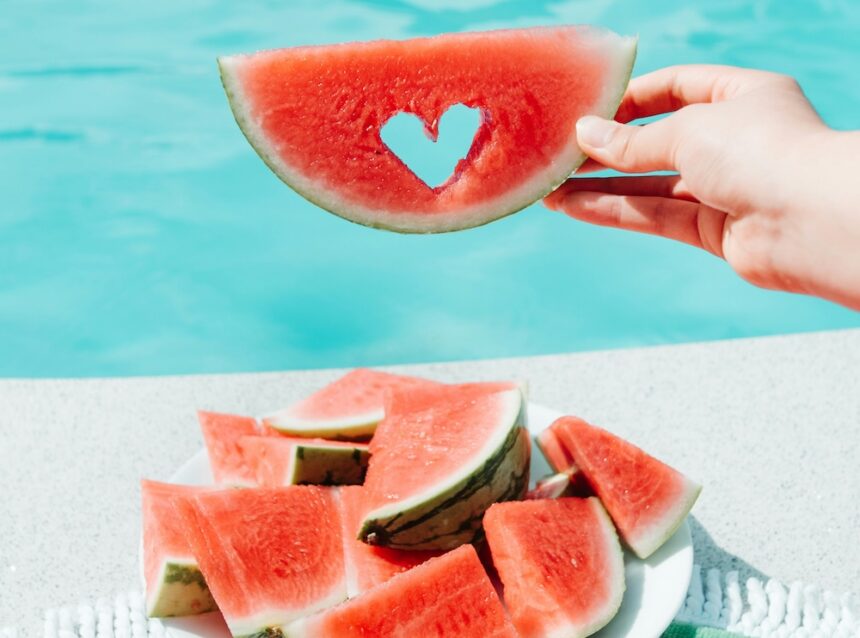
Watermelon looks almost suspiciously well suited to dieting. It is sweet, voluminous, refreshing, and low enough in calories that you can eat a substantial bowl without demolishing your daily calorie target. That makes it an appealing alternative to the miserable portions often associated with weight-loss diets.
So, is watermelon good for weight loss? Yes, it can be. Watermelon is a low-energy-density food that may help you eat a satisfying volume for relatively few calories. However, it does not burn fat, “detox” your body, accelerate your metabolism, or possess any other magical property invented by wellness influencers desperate for engagement.
Watermelon helps with weight loss when it replaces a more calorie-dense food and makes maintaining a calorie deficit easier. If you simply add half a watermelon on top of everything you already eat, the fruit has not suddenly discovered a loophole in human metabolism. Calories still count, even when they arrive in an aesthetically pleasing pink package.
Is Watermelon Good for Weight Loss?
Watermelon can be an excellent weight-loss food because it provides a large physical portion for surprisingly few calories. According to USDA-derived food composition data, 100 grams of raw watermelon provides approximately 30 calories, while one cup of diced watermelon contains around 46 calories. It consists of more than 91% water and contains almost no fat.
A typical cup of diced watermelon contains approximately:
- 46 calories
- 11.5 g of carbs
- 0.6 g of fiber
- 0.9 g of protein
- 0.2 g
Watermelon is not exceptionally rich in fiber, protein, or fat, so it should not be crowned the ultimate satiety food. Its main weight-loss advantage comes from water, volume, and low calorie density rather than a particularly impressive macronutrient profile.
For comparison, two cups of watermelon provide roughly 92 calories. That is a sizeable bowl of food for fewer calories than many cereal bars, cookies, coffee-shop drinks, or supposedly “healthy” protein snacks. Whether that helps you lose weight depends on what those two cups replace.
That distinction matters. Eating watermelon instead of a 400-calorie dessert may meaningfully reduce your daily intake. Eating watermelon after the dessert merely adds another 92 calories.
Why Watermelon May Make a Calorie Deficit Easier
Weight loss requires a sustained energy deficit. No fruit, spice, tea, supplement, or viral concoction overrides that basic requirement. The useful question is therefore not whether watermelon directly burns fat. It does not. The useful question is whether eating it can make a calorie deficit less unpleasant.
Watermelon may help through its low energy density. Energy density describes how many calories a food contains relative to its weight or volume. Foods packed with water tend to provide more physical bulk for fewer calories, whereas foods rich in fat, refined starch, and added sugar can deliver hundreds of calories in several forgettable bites.
Research on dietary energy density suggests that reducing the energy density of meals can lower total energy intake without necessarily requiring people to eat dramatically smaller portions. Low-energy-density foods can also increase fullness because they occupy more space in the stomach and take longer to eat than a tiny, calorie-dense snack.
This is where watermelon earns its place in a weight-loss diet. You can eat 300 grams of watermelon for roughly 90 calories. The same calorie amount would buy you only a small quantity of chocolate, crisps, pastries, or nuts.
That does not make those foods inherently forbidden. It simply means watermelon gives you more food for your calorie budget. For someone who struggles with tiny portions and persistent hunger, that is not a trivial advantage.
The strongest argument for watermelon is substitution:
- Replace ice cream with chilled watermelon.
- Replace biscuits with a bowl of diced watermelon.
- Replace a sugary drink with water infused with watermelon pieces.
- Replace part of a calorie-heavy dessert platter with fresh fruit.
- Add watermelon to a meal instead of relying on a large quantity of bread, chips, or another energy-dense side.
What does not work is treating watermelon as a free food and eating unlimited quantities alongside your normal diet. A low-calorie food can still contribute a meaningful number of calories when the portion becomes enormous.
What Does the Research Actually Show?
There is some direct human research on watermelon and weight management, but the evidence is much thinner than enthusiastic health articles often imply.
A 2019 crossover study included 33 adults who were overweight or obese. Participants consumed either two cups of fresh watermelon or an equal-calorie portion of low-fat vanilla wafer cookies each day for four weeks. The watermelon provided 92 calories, as did the cookie snack.
Compared with the cookies, watermelon produced greater reported fullness and lower hunger, desire to eat, and expected food consumption. Hunger remained lower for up to 90 minutes following watermelon, while the cookies reduced hunger for a much shorter period.
After four weeks, average body weight fell from approximately 89.4 to 88.9 kilograms during the watermelon phase. During the cookie phase, it increased from approximately 89.3 to 89.9 kilograms. The watermelon phase was also associated with a modest reduction in BMI and a better waist-to-hip ratio compared with the cookie phase.
That sounds promising. It is not, however, permission to declare watermelon a clinically proven fat-loss treatment. It’s worth to mention that this specific study also had several substantial limitations:
- It included only 33 people.
- Each intervention lasted four weeks.
- All participants completed the watermelon phase before the cookie phase, creating a possible order effect.
- Body-fat percentage did not significantly decrease during the watermelon phase.
- The study was funded by the National Watermelon Promotion Board.
The researchers themselves acknowledged the possible order effect and uncertainty about which aspects of watermelon produced the observed response.
The approximately half-kilogram reduction in body weight also cannot automatically be described as half a kilogram of lost body fat. Since body-fat percentage did not significantly change, shifts in water, glycogen, digestive contents, or measurement variability may have contributed.
The sensible conclusion is that fresh watermelon may improve fullness and support weight management when it replaces a refined snack. The evidence does not prove that watermelon itself causes substantial or lasting fat loss.
Is Watermelon Filling Enough to Prevent Hunger?
Watermelon can feel filling in the short term because it provides substantial volume and water. The human study comparing watermelon with cookies supports this: participants reported greater fullness and less hunger after the watermelon snack.
However, watermelon is low in fiber, protein, and fat—the three components that often help meals provide more lasting satisfaction. One cup contains less than one gram of fiber and roughly one gram of protein. A bowl of watermelon may fill your stomach temporarily without holding hunger away for an entire afternoon.
For better staying power, combine a sensible portion with a protein source, such as:
- Greek yogurt or skyr
- Cottage cheese
- A small serving of nuts
- Feta cheese in a watermelon salad, provided the amount of cheese and dressing remains reasonable
Pairing watermelon with something more substantial does add calories. That is not a flaw. A 180-calorie snack that keeps you satisfied may be more useful than a 50-calorie snack followed by uncontrolled grazing through the kitchen.
Is Watermelon Juice Good for Weight Loss?
Watermelon juice is not automatically unhealthy, but it is less useful for weight management than eating the whole fruit.
Juicing or blending makes it easier to consume a much larger quantity quickly. Drinking calories generally requires less chewing and less time than eating the same food in solid form. Whole fruit also retains its physical structure, which may contribute to fullness beyond fiber content alone.
The watermelon study’s authors noted that previous human trials using watermelon juice or powder had not found the same body-weight changes. They suggested that whole watermelon may produce greater satiety because it has more volume and requires chewing.
A glass of homemade watermelon juice may still be preferable to a soft drink, particularly if it contains no added sugar. But the word “juice” should not be used to launder calories into invisibility.
Commercial watermelon drinks can also contain added sugar, syrups, other fruit concentrates, or surprisingly large serving sizes. A product featuring a photograph of fresh fruit on the bottle is not proof that the contents are suitable for weight loss. Read the actual ingredients and nutrition label rather than allowing the packaging department to make dietary decisions for you.
Whole watermelon is generally the better choice because it is slower to consume, easier to portion, and more physically satisfying.
Final Verdict: Is Watermelon Good for Weight Loss?
Watermelon’s high water content and low energy density allow you to eat a generous portion for relatively few calories. Early human evidence suggests that whole watermelon may produce greater short-term fullness than an equal-calorie refined snack. However, the direct research is limited, short-term, and partly industry-funded. It does not prove that watermelon independently causes significant fat loss.
Watermelon also has weaknesses. It contains little fiber and protein, can be easy to overeat, and may cause digestive symptoms in people sensitive to excess fructose. Its sugar content is not a reason to fear it, but neither is its status as fruit a reason to abandon portion awareness.
Eat watermelon because it is refreshing, enjoyable, and useful for replacing more calorie-dense foods. Do not eat it because someone online claimed it flushes fat from your stomach.
Watermelon can support weight loss. It cannot do the work of an entire diet.